Hilo, HI
Paiāulu
Paiāulu is a community capacity partner dedicated to protecting culture while strengthening the systems that help communities thrive. The nonprofit organization supports local leaders, organizations, and initiatives by filling gaps, coordinating resources, and building sustainable infrastructure. When culture is honored and protected, communities grow stronger together. Established in February 2026, this organization was born from a shared conviction: that legacy and the pursuit of moving our kaiāulu out of "just surviving" and into thriving for the many generations that come, really is the whole point.
Sector
Entrepreneurship
Consulted
2026
Reputation Analysis
The brand entered a crowded and saturated nonprofit landscape on Hawaiʻi Island. Without an existing reputation to build from, the brand’s initial challenge was building immediate credibility and consideration. By bringing together a board of directors with decades of experience, the brand had the blocks to build its foundations of its visual brand identity. Without such, the brand risked vulnerabilities that comes with a brand with no visual recognition: lack of awareness, consideration, and overall trust.

Positioning Shift
There was an opportunity to build a professional, credible, and bold presence within Hawaiʻi’s nonprofit sector. Although no direct competitors matched their scope, their success hinged on the expertise of a founding board of directors. This foundation solidifies the brand as a trustworthy partner, positioning them alongside the most respected leaders on the island.
Solution
The creative strategy centered around the concept of the ahupuaʻa system and the values intrinsic to the Hawaiian economic and social systems. By anchoring the brand in this mindset, every visual direction and communication was informed by a deep-rooted sense of place, kuleana, and intergenerational stewardship.

Design Thinking
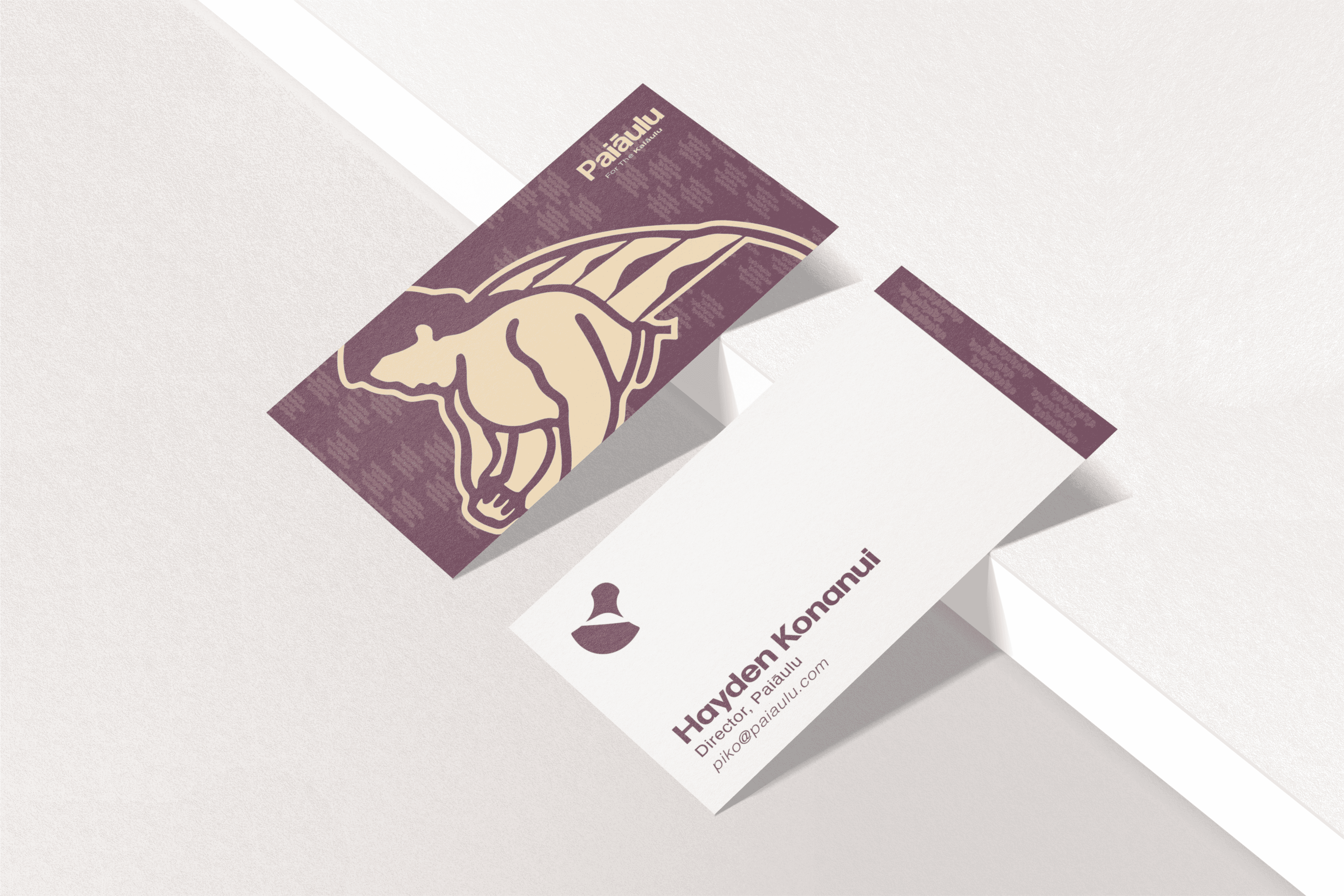
The design thinking centered on the image of "dual purpose." A kāne figure carrying an ʻupena, and a wāhine figure utilizing a pōhaku kuʻi ʻai, was chosen to frame a duality that reflects the traditional and modern ahupuaʻa symbolizing the reciprocal balance of upland and ocean. This mirrored the circular economy philosophy of the organization, with the man and woman representing complementary roles in Hawaiian culture. Selected colors were drawn from the richness of the land: a deep plum purple, warm yellows, and grounding grays. These colors reflect abundance, sunrise, and the vitality of food. Even the subtle tilt of the poi pounder in the favicon signals motion, underscoring the action-oriented nature of Paiāulu’s work.


